


Different welding projects need different types of welds. Welding joints are made to stand up to the needs and forces of each individual application.
The 5 Types of Welding Seams to Know
Understanding welding seams is an essential part of being a professional welder. Let’s dive into the 5 types of welding seams below.
Fillet Welded Seams
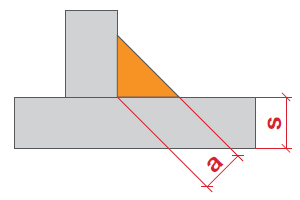
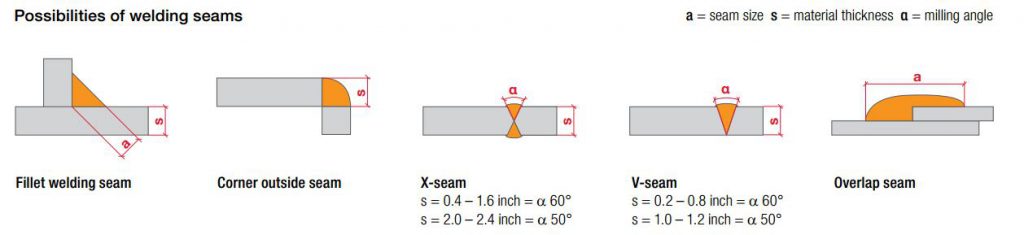
Fillet Welded Seams are a term for corner, lap, and tee joints. Fillet Welded Seams are the most common type of welding joint. They account for nearly 75% of joints made with arc welding. You do not need to prepare the edge as this type of joint makes it easy to weld piping systems. Butt welds are more expensive than fillet welds. Fillet welds are mostly used in piping systems to join pipe to socket joints.
Cliffswelding claims, welding joints can be prepared in numerous ways including:
- Casting
- Shearing
- Machining
- Forging
- Filing
- Stamping
- Oxyacetylene cutting (thermal cutting process)
- Routing
- Grinding
- Plasma arc cutting (thermal cutting process)
Corner Outside Seams

Corner Outside Seams are one of the most popular welds in the sheet metal industry the corner welding joint is used on the outer edge of the piece. This welding seam is a type of joint that comes together at right angles between two metal parts to form an L. These are common during the construction of boxes, box frames, and similar fabrications.
Welding Styles Used To Create Corner Joints:
- Spot weld
- Fillet weld
- V-groove weld
- Square-groove weld or butt weld
- U-groove weld
- Bevel-groove weld
- Flare-V-groove weld
- J-groove weld
- Corner-flange weld.
- Edge weld
X-Seams
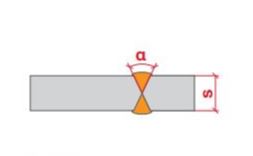
The double-V seam is also known as an X-seam and double V-joint. It is a type of butt welding seam and consists of a combination of two V-seams on each of the two sides of the components to be joined.
Single butt welds are similar to a bevel joint, but instead of only one side having the beveled edge, both sides of the weld joint are beveled. A double-V joint seam is used in thick metals and when welding can be performed from both sides of the workpiece.
When welding thicker metals, a double-V joint requires less filler material because there are two narrower V-joints compared to a wider single-V joint. The double-V joint helps compensate for warping forces. With a single-V joint, stress tends to warp the piece in one direction when the V-joint is filled, but with a double-V-joint, there are welds on both sides of the material, having opposing stresses, straightening the material.
V-Seams

In order to achieve the V-shaped angle that is typical for the V-seam, the workpieces are either beveled or positioned at an appropriate angle to each other. This is required in order to complete a V-Seam welding seam.
Overlap Seams
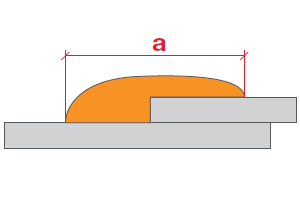
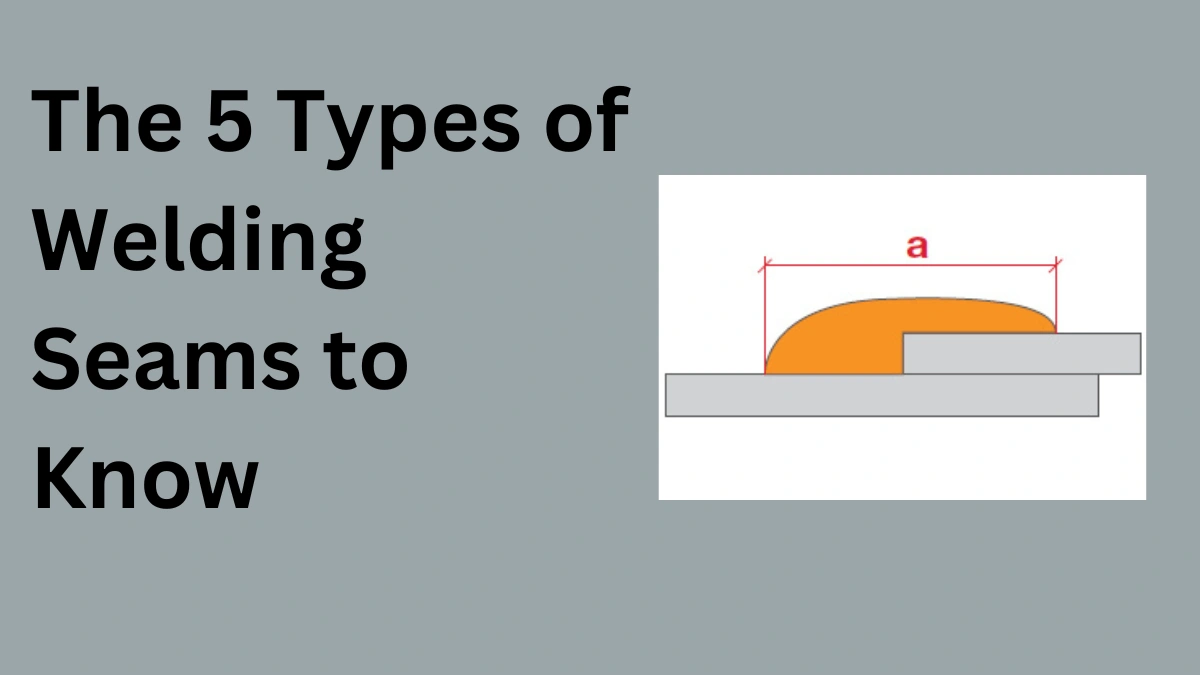
An overlap seam is when one seam overlaps another to form a continuously welded and leak tight welding seam. This seam looks clean and put together. Ideal for floor and roof welding projects.
Are you having an issue fixing a leak? Here is a video of how you can fix a leaking seam. We hope these 5 welding seams give you a better understanding and will help you in your next welding project.
Shop Welding Tools at Hot Air Tools®:
If you need a new welding tool to complete a project or need service on your welding tools, fill out our Contact Us Form or give us a call at 800.694.1472! Check out our full selection of plastic welding tools.